UK Nano Influencer Marketing: Small Audiences, Serious Influence
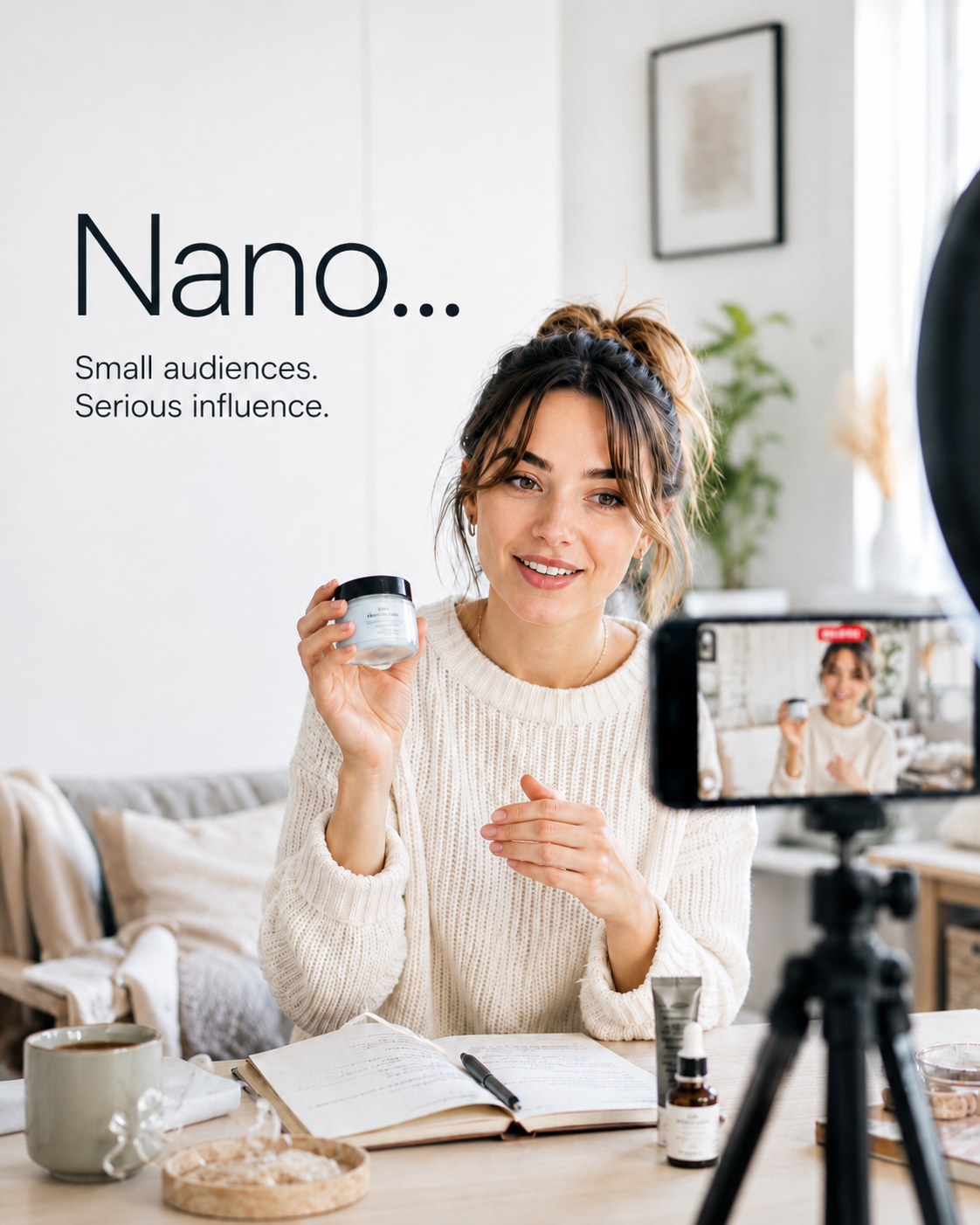
UK Nano Influencer Marketing gives brands another option working with smaller creators whose audiences may be more specific, local and genuinely interested in what they have to say. Britain has not exactly fallen out of love with big-name influencers. It has simply become less dazzled by follower count. For an independent restaurant, emerging beauty label, specialist retailer or ambitious SME, relevance can be considerably more useful than reaching hundreds of thousands of people who were never likely to buy.
This is not a fringe tactic. A recent European industry study found that 93% of surveyed UK brands and agencies work with micro-influencers, while 81% expected their influencer budgets to increase in 2026. The terminology varies, but the direction is clear smaller creators have become a serious part of the marketing mix.
What you need to know: UK Nano Influencer Marketing
Nano influencers generally have between 1,000 and 10,000 followers
Their value lies in audience relevance, credibility and content quality not simply follower numbers
UK pricing varies widely, with video, usage rights and exclusivity usually increasing the fee
Gifted products are not automatically “free marketing”
Paid, gifted and affiliate content must be clearly disclosed
Campaign success should be measured against business objectives, not likes alone
What is a nano influencer?
A nano influencer is generally understood to be a social media creator with approximately 1,000 to 10,000 followers. Creators with 10,000 to 50,000 followers are normally classed as micro-influencers, although agencies and platforms do not all use precisely the same thresholds.
The word “nano” can sound rather apologetic. It should not.
A creator with 4,000 followers who regularly reviews independent London restaurants may be far more valuable to a new neighbourhood opening than a lifestyle personality with 500,000 followers scattered across several countries.
The smaller account does not provide the greatest theoretical reach. It may, however, provide a better concentration of the people the restaurant actually wants through the door.
That distinction sits at the heart of effective influencer marketing:
Reach tells you how many people could see something. Relevance tells you whether the right people might care.
Why can UK Nano Influencer Marketing work so well?
Nano influencers are not automatically more persuasive, more honest or more effective than larger creators. A small audience can still be disengaged, badly matched or inflated.
Their advantage appears when the creator, audience and campaign are properly aligned.
Their communities are often more specific
Many smaller creators build their accounts around a recognisable interest, location or lifestyle.
That could include:
- Affordable skincare for sensitive skin
- New restaurant openings in South West London
- Independent British fashion
- Family days out in Surrey
- Sustainable home renovation
- Running clubs and fitness communities
- Specialist food, travel or professional interests
A tightly defined audience helps a brand reduce wasted exposure. Instead of paying primarily for scale, it can invest in context.
Their content can feel more natural
Nano creators are often closer to the everyday social media user than the highly polished celebrity end of the market.
This can make their content feel more at home in a person’s feed. The camera work may be simpler. The language may be less rehearsed. The product does not always arrive accompanied by a lighting crew, a wind machine and the faint suspicion that nobody involved has ever used it before.
That does not mean brands should accept poor-quality content. It means that polish and persuasiveness are not the same thing.
Smaller creators may deliver stronger engagement
Published global Instagram benchmarks cited by Shopify reported an average engagement rate of 1.73% for nano creators, compared with 0.61% for macro influencers. These figures should be treated as broad benchmarks rather than promises platform, category, audience and content quality can all change the outcome.
The useful lesson is not that nano creators always win. It is that follower count alone is a weak predictor of campaign value.
A brand can spread its risk
A budget assigned to one high-profile personality could potentially be divided across several smaller creators.
That approach may provide:
- A wider variety of creative treatments
- Access to several niche communities
- More content for the brand to assess
- Less dependence on one personality
- Better insight into which messages and audiences respond
UK Nano Influencer Marketing also creates more administration. Ten smaller collaborations mean ten sets of conversations, approvals, deadlines and reporting. The economics only make sense when the campaign is organised properly.
Which businesses benefit from UK Nano Influencer Marketing?
Nano influencers tend to work particularly well when a business needs specific influence rather than mass fame.
They can be a strong fit for:
Local businesses
Restaurants, salons, clinics, gyms, venues, attractions and retailers can work with creators whose followers are concentrated in the right town, borough or region.
A creator’s location should be checked through audience analytics rather than assumed from the address in their biography.
Beauty, wellness and fashion brands
These sectors naturally lend themselves to demonstrations, routines, styling, reviews and before-and-after storytelling.
However, brands must take particular care with product claims. A creator should not make medical, therapeutic or performance claims that the business itself could not substantiate.
Food and hospitality
Nano creators can introduce a restaurant, hotel or experience to a highly relevant local audience. The strongest content normally shows the experience in the creator’s usual style rather than reproducing a corporate advert with a plate of pasta in the background.
Niche products and services
Specialist products often need explanation as much as exposure. A smaller creator who already understands the category may communicate the value more convincingly than a larger general-interest account.
Brands testing a new audience
Nano partnerships can help a business test different communities, messages and content formats before committing a larger budget.
They are not a substitute for strategy. They are a practical way to gather evidence.
How much do UK nano influencers charge?
There is no official UK rate card, and any article claiming there is deserves a raised eyebrow.
One current UK benchmark places nano creator fees at approximately £40 to £250 for a sponsored post and £80 to £400 for video content. These figures are useful as an initial reference only not as a tariff that every creator should follow.
A creator’s quote may be affected by:
- Average reach and engagement
- Audience location and demographics
- Platform and content format
- The complexity of filming or editing
- The number of deliverables
- Turnaround time
- Exclusivity restrictions
- Revision requirements
- Whether the brand wants to reuse the content
- Whether the content will appear in paid advertising
- The creator’s category knowledge or professional expertise
A 20-second Reel filmed at home is not the same assignment as travelling to a location, attending an event, scripting a demonstration and delivering edited content in several formats.
A practical UK Nano Influencer Marketing cost guide
Campaign element | Indicative consideration |
Gifted product | No guaranteed post unless an agreement has been made |
Sponsored static post | Often towards the lower end of the creator’s pricing |
Instagram Reel or TikTok | Commonly more expensive because of production and editing |
Stories | May be priced individually or included in a package |
Content usage rights | Should normally be agreed and priced separately |
Paid media usage | Requires explicit permission and may carry an additional fee |
Category exclusivity | May increase the cost because it limits the creator’s future work |
Event attendance or travel | Expenses and time should be agreed in advance |
The sensible question is not, “How cheaply can we get this creator?”
It is, “What are we paying for, and how will it help the campaign?”
Gifting is not the same as free marketing
Sending a product to a creator does not guarantee coverage.
Unless content has been agreed, the recipient may choose not to post. They may try the product and decide it is not suitable. They may mention it briefly, feature it months later or pass it to someone else.
That is part of the difference between gifting and a contracted collaboration.
Gifting can still be valuable for product discovery and relationship-building, but brands should not build a launch forecast around posts nobody has promised to publish.
UK disclosure requirements also apply to more than straightforward cash payments. CMA guidance says promotional content resulting from payments, gifts or other incentives should be clearly labelled as advertising, including where a brand does not control the final post or request specific wording.
Free product may remove money from the transaction. It does not remove the commercial relationship.
How to find the right nano influencers
Influencer selection should begin with the customer, not the creator.
Before searching, define:
- Who the campaign needs to reach
- Where that audience lives
- What action the campaign should encourage
- Which platform suits that action
- What type of content the audience is likely to trust
- What would make a creator unsuitable
Then assess potential partners against the following criteria.
- Audience location
A UK-based creator does not necessarily have a predominantly UK audience.
Request recent platform insights showing audience country, city, age and gender where these details are relevant to the campaign.
- Average reach
Follower count is visible. Reach is more useful.
Review average Reel views, Story views and post reach across a reasonable period. Do not base a decision on one viral video.
- Engagement quality
Read the comments.
Are people asking questions, sharing experiences and discussing the subject, or is the engagement largely a parade of generic compliments and suspiciously enthusiastic fire emojis?
Saves, shares, replies and link clicks may reveal more intent than likes.
- Content compatibility
The creator’s existing style should make sense for the brand.
A partnership usually performs better when the product fits naturally into content the audience already expects. Hiring a creator and then asking them to become a completely different person is an expensive route to awkward content.
- Previous brand partnerships
Check how often the creator posts advertisements, which competitors they have worked with and whether commercial relationships are disclosed properly.
A feed containing little but consecutive sponsored posts may struggle to make any single recommendation feel meaningful.
- Reputation and brand safety
Review older content as well as recent posts.
Look for offensive material, misinformation, erratic behaviour, unresolved disputes or opinions that conflict significantly with the brand’s values. The objective is not to find a person with no personality. It is to avoid discovering their most controversial one after the invoice has been paid.
- Commercial professionalism
A reliable nano influencer should be able to discuss deliverables, deadlines, rates, usage rights, reporting and disclosure.
A smaller following does not justify a smaller standard of organisation.
UK influencer rules: when is an ad an ad?
In the UK, both the brand and the influencer share responsibility for making advertising clearly identifiable.
The ASA advises using an upfront and prominent label such as “Ad”. Merely tagging the brand is not enough, and the word “sponsored” can be too ambiguous when used on its own. Affiliate links and discount codes can also create an advertising relationship because the creator may earn commission from the resulting clicks or sales.
This is not a technicality hidden in the small print. ASA research published in 2026 found that many people struggle to distinguish influencer advertising from ordinary content and expect disclosures to be immediately visible without clicking or searching for an explanation. Clear “Ad” labels and prominent platform disclosures performed best.
Brands should therefore include disclosure requirements in every brief and contract.
The label should be obvious:
- At the start of a caption rather than buried among hashtags
- On every relevant Story frame
- Visible early in video content
- Clear on affiliate content
- Repeated where content appears in several formats
Transparency does not ruin good influencer content. Confusion does.
How to brief nano influencers without ruining what made them useful
A brief should provide direction without scripting every breath.
Include:
- The campaign objective
- The intended audience
- Required deliverables
- Product facts and substantiated claims
- Key dates
- Mandatory disclosure wording
- Prohibited claims or sensitive topics
- Approval requirements
- Usage rights
- Reporting expectations
- Contact details for questions
Then leave room for the creator’s own voice.
The creator understands how their audience responds to content. The brand understands the product, campaign and commercial risks. Good work happens when both forms of knowledge are respected.
How should a nano influencer campaign be measured?
The correct metrics depend on the objective.
For awareness
Measure:
- Unique reach
- Video views
- Completion rate
- Frequency
- Audience location
- Brand mentions and search interest
For engagement and consideration
Measure:
- Saves
- Shares
- Meaningful comments
- Story replies
- Profile visits
- Website visits
- Direct messages or enquiries
For sales or lead generation
Measure:
- Tracked links
- Discount-code use
- Purchases
- Bookings
- Leads
- Cost per acquisition
- Revenue attributed to the campaign
For content production
Measure:
- Number of usable assets
- Quality and variety of content
- Organic performance
- Paid advertising performance
- Production costs avoided
- Length and scope of usage rights
Likes are not useless. They are simply not a business model.
Use UTM links, unique codes, dedicated landing pages and post-campaign reporting wherever possible. Agree on the reporting requirements before content is published, not three weeks later when everyone is trying to reconstruct the campaign from screenshots.
When are nano influencers the wrong choice?
Nano influencers are not the answer to every brief.
They may be less suitable when:
- The business needs rapid national reach
- The campaign relies on a single high-profile announcement
- Production requirements exceed the creator’s abilities
- The category involves complex regulatory or reputational risk
- The brand cannot manage several creator relationships
- The audience is too broad to target efficiently through small communities
- The campaign has no tracking, offer or meaningful next step
Sometimes one larger creator is more efficient than managing twenty small ones. Sometimes paid social advertising will provide better control. Often the strongest plan combines creator content, PR, social media and paid amplification rather than asking one channel to perform every job.
Small audience, serious strategy
Nano influencer marketing works best when a brand stops treating creators as rented follower counts.
The real value sits in the match between the person, the audience, the message and the business objective. A carefully selected creator with 3,000 relevant followers may produce useful content, credible conversation and measurable enquiries. A poorly selected creator with 300,000 followers may produce a very expensive shrug.
At RED Marketing, we manage influencer identification, outreach, gifting, paid partnerships, briefs, content approvals and campaign reporting as part of our PR and influencer marketing services. We also connect creator campaigns with broader social media strategy, content creation and paid advertising, so the activity has somewhere useful to lead.
Because influence is not simply the ability to be seen.
It is the ability to make the right person pay attention.
RED Marketing
78 York St, London W1H 1DP, United Kingdom
Phone: +44 7874 160 831
Web: https://www.redmarketing.biz
Frequently asked questions
How many followers does a nano influencer have?
A nano influencer generally has between 1,000 and 10,000 followers. The exact thresholds vary between platforms and agencies.
How much does a nano influencer cost in the UK?
A current broad UK benchmark suggests approximately £40 to £250 for a sponsored post and £80 to £400 for video. Actual rates depend on reach, niche, production, platform, usage rights, exclusivity and campaign scope.
Do gifted influencer posts need to be labelled as ads?
Where content results from a gift, payment or other incentive, UK guidance requires the commercial relationship to be made clear. Brands should require a prominent “Ad” disclosure rather than relying only on a brand tag or vague wording.
Are nano influencers better than celebrity influencers?
Not automatically. Nano influencers can be more useful for niche, local or community-focused campaigns, while celebrity and macro creators may be more effective when rapid mass awareness is the main objective.
What should a nano influencer contract include?
It should cover deliverables, deadlines, payment, approval processes, disclosure, usage rights, paid advertising permission, exclusivity, cancellation, reporting and any prohibited claims.
How do you measure nano influencer marketing?
Use metrics connected to the campaign objective, such as qualified reach, saves, shares, clicks, enquiries, bookings, sales, cost per acquisition and the value of reusable content.