Meta vs Google Ads: Has Social Advertising Overtaken Search?
Meta vs Google Ads: For years, Google was the undisputed heavyweight of digital advertising. Businesses paid to appear at the precise moment someone searched for a product, service or answer.
Meta took a different route.
Rather than waiting for consumers to tell it what they wanted, Facebook and Instagram became remarkably good at predicting what might interest them next.
That difference sits at the heart of the Meta vs Google Ads debate — and it may explain why Meta is now forecast to overtake Google in worldwide digital advertising revenue.
According to EMARKETER, Meta is expected to generate approximately $243.46 billion in net worldwide advertising revenue during 2026, slightly ahead of Google’s forecast $239.54 billion. It would be the first time Meta has taken the lead. Importantly, this is a forecast rather than a confirmed full-year result. (Reuters)
That may sound like a battle between two enormous technology companies. For UK businesses, however, it points to something far more relevant:
The way people discover and buy products is changing.
Key takeaways
- Meta is forecast to overtake Google in net digital advertising revenue during 2026.
- Meta is particularly effective at creating demand before someone begins searching.
- Google remains powerful when a consumer already knows what they need.
- AI, short-form video and automated targeting are changing how campaigns are built.
- The strongest advertising strategy will often use Meta and Google at different stages of the same customer journey.
Has Meta really overtaken Google?
Not quite — at least, not yet.
The widely shared headline is based on an EMARKETER forecast for net worldwide advertising revenue during 2026. It does not mean Meta has already reported higher total advertising revenue than Google for a completed financial year.
There are also differences in how researchers and companies calculate advertising income. Net revenue forecasts may deduct costs such as traffic acquisition and payments to content partners, so they should not be treated as a direct comparison with every figure appearing in Meta’s or Alphabet’s financial statements.
Still, the direction of travel is difficult to ignore.
Meta reported advertising revenue of just over $55 billion for the first quarter of 2026, up 33% from the same period in 2025. (Meta Investor)
The interesting story is not simply that Meta may move a few billion dollars ahead of Google. It is how quickly social advertising has evolved from a place to promote content into an increasingly sophisticated sales and discovery system.
Why Meta advertising is growing so quickly
A podcast conversation that inspired this article made a useful distinction: Google depends heavily on the search someone types, while Meta can find potential customers based on a much broader collection of behavioural signals.
That does not make one platform universally better. It means they begin at different points in the buying process.
Meta can create demand before a search happens
Google is at its strongest when someone expresses clear intent.
A person searches:
- “Emergency plumber near me”
- “Private GP appointment London”
- “Best accountancy software for small business”
- “Buy prescription sunglasses online”
The need already exists. Google helps the business appear while the customer is actively looking for an answer.
Meta often reaches the customer earlier.
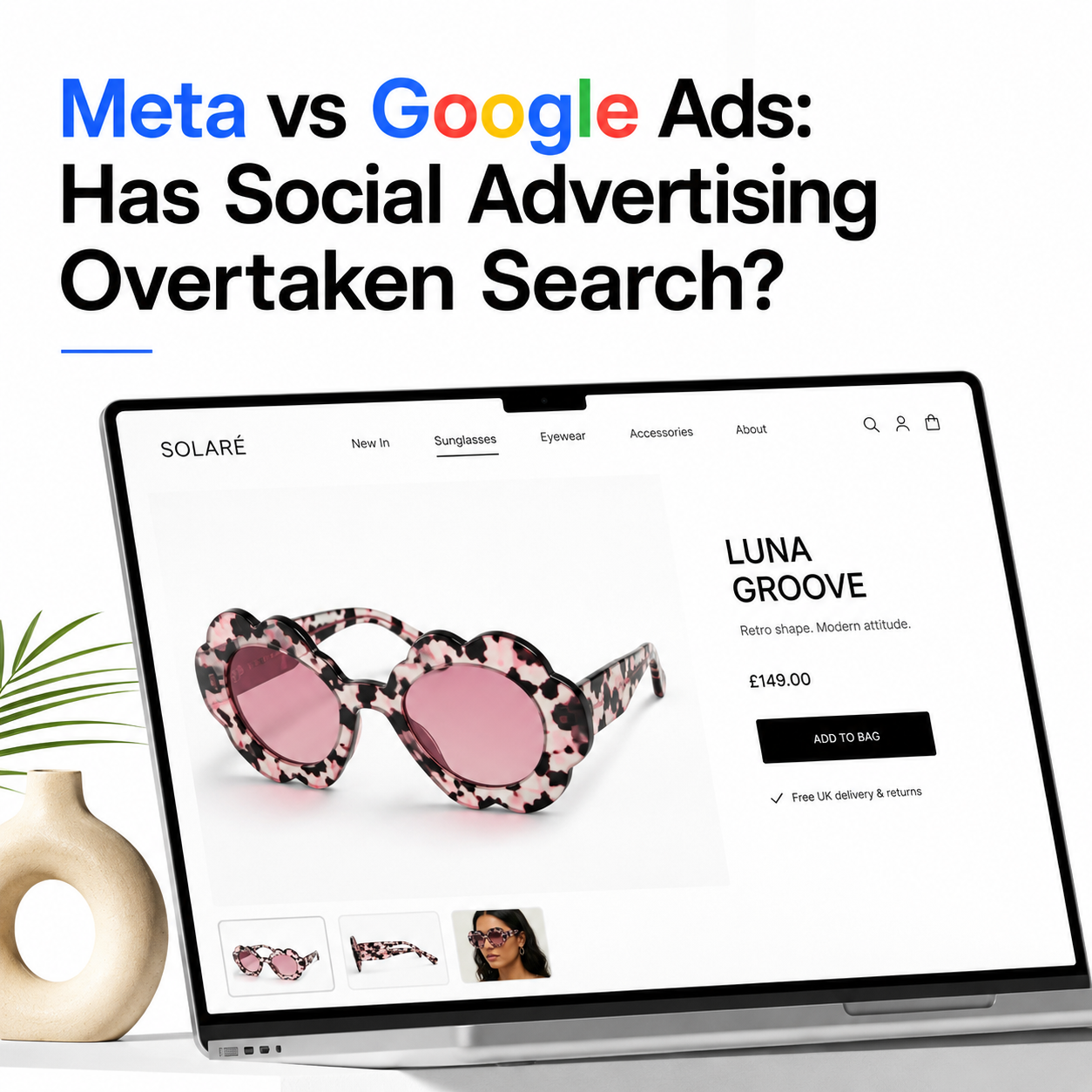
Someone scrolling through Instagram may have had no intention of buying sunglasses that morning. Then a well-produced Reel, carousel or product advert introduces them to a design they have never seen before.
The advert has not captured an existing search. It has created interest.
That ability is particularly valuable for fashion, beauty, food, travel, fitness, hospitality, events and other visually driven sectors where desire can be sparked by the creative itself.
Meta has reduced its reliance on narrow audience targeting
Social advertising once involved building highly detailed audiences manually. Advertisers selected age groups, locations, interests, behaviours and numerous demographic characteristics.
Those controls still have a role, but Meta increasingly encourages advertisers to give its systems more freedom.
Meta describes Advantage+ as a collection of AI and automation tools designed to optimise areas such as audiences, placements, budgets and campaign performance. Its automated sales campaigns use machine learning to find people considered more likely to convert. (Facebook)
In practical terms, an advertiser can provide:
- A clear commercial objective
- Strong creative material
- An appropriate budget
- Reliable conversion data
- Sensible geographic limitations
Meta’s systems then test where, when and to whom the advertising should appear.
It is a significant shift. Media buying is becoming less about finding the perfect collection of interest categories and more about giving the algorithm the right signals and enough quality content to work with.
Social adverts increasingly resemble social content
A traditional search advert is visibly functional. It presents a headline, description and link in response to a query.
Meta advertising can take the form of:
- Reels
- Stories
- Carousels
- Product demonstrations
- Creator collaborations
- Customer testimonials
- Before-and-after content
- Short educational videos
The strongest adverts often look and feel similar to the content surrounding them.
That does not mean businesses should disguise advertising or make misleading claims. It means the creative needs to earn attention in the same environment as entertainment, personal updates, recommendations and creator content.
The advert has to be worth watching.
Does that mean Google Ads is becoming irrelevant?
No. Very far from it.
“Google is finished” makes a punchy social media caption. It makes a less convincing marketing strategy.
Google Ads remains one of the most effective channels available when people are actively researching, comparing or preparing to buy. Search continues to attract substantial advertising investment because it captures consumers at the moment they express a need. (EMARKETER)
Consider the difference between these two situations:
A consumer sees an advert for an interesting new skincare serum while browsing Instagram. Meta has introduced the product and created curiosity.
Two weeks later, the same consumer searches for the brand name, reads reviews, compares prices and looks for a UK stockist. Google is now capturing the demand Meta helped create.
The platforms are not always competing for the same moment. They can be influencing different stages of one decision.
AI is changing search rather than simply replacing it
Search behaviour is becoming more fragmented.
Consumers can now ask questions through Google, ChatGPT, Gemini, marketplaces, TikTok, YouTube, Reddit and social platforms. A product discovery may begin with a Reel, continue through an AI assistant and end with a Google search or direct website visit.
EMARKETER reports that AI assistants are absorbing a growing number of queries, particularly during the research stage. At the same time, it stresses that paid search continues to work for high-intent branded and commercial searches. (EMARKETER)
For businesses, this means visibility can no longer depend on one search engine or one advertising platform.
A modern strategy may need to include:
- Search advertising for immediate intent
- Social advertising for discovery and demand creation
- SEO for organic visibility
- AEO and GEO for inclusion in AI-generated answers
- Reviews and reputation management
- High-quality website content
- Remarketing across multiple platforms
The customer journey has become less like a straight line and more like a browser with seventeen tabs open.
Meta vs Google Ads for UK businesses
The right platform depends on what the business is selling, how quickly the customer makes a decision and whether demand already exists.
Business objective | Meta Ads | Google Ads |
Introduce an unfamiliar product | Strong | More limited without existing searches |
Generate immediate local enquiries | Useful | Often very strong |
Promote a visually striking product | Strong | Useful through Shopping and Performance Max |
Capture emergency or urgent demand | Limited | Strong |
Build awareness through video | Strong | Strong through YouTube |
Reach people before they begin searching | Strong | More limited |
Capture branded searches | Useful for remarketing | Strong |
Sell through social proof and creators | Strong | More limited |
Reach high-intent service buyers | Useful | Strong |
Meta may deserve priority when:
The product is visual, new or emotionally appealing. Strong examples include clothing, beauty, interiors, restaurants, events, tourism and ecommerce products.
Meta can also work well where the audience is broad but difficult to describe through a small number of keywords.
Google may deserve priority when:
The customer is already searching for a clear solution.
This applies particularly to local services, professional services, medical appointments, repairs, legal support, property services and other categories where timing and intent matter.
A person searching “boiler repair Richmond” is unlikely to need a beautifully choreographed Reel. They need someone nearby who can fix the boiler.
Should businesses move budget from Google to Meta?
Not automatically.
Following global advertising revenue forecasts without examining your own campaign data would be a little like changing restaurants because another table ordered something interesting.
The better questions are:
- Where do our customers first discover us?
- Which platform creates qualified enquiries?
- Which campaigns contribute to assisted conversions?
- How long does a customer take to decide?
- Does our product need to be discovered or actively searched for?
- Are we measuring revenue rather than clicks alone?
- Is our creative strong enough for social advertising?
- Does our website convert the traffic we already receive?
For many UK businesses, the most effective approach will be a coordinated one.
Use Meta to create attention, familiarity and demand. Use Google to capture the searches that follow.
Meta can introduce the brand. Google can collect the customer when they are ready to act.
Remarketing can then reconnect with people who visited, watched, clicked or added a product to their basket without completing the purchase.
The real winner is the customer journey
Meta overtaking Google would be symbolically significant. Google has shaped digital advertising for more than two decades, while Meta has built a system capable of generating demand within the environments where people socialise, watch, browse and shop.
But the headline should not tempt businesses into choosing sides too quickly.
Meta has become exceptionally good at finding potential customers before they express an obvious need.
Google remains exceptionally good at responding once that need becomes a search.
The question is no longer simply Meta vs Google Ads.
It is whether your marketing reaches customers at every important stage between discovering a business and deciding to buy from it.
At RED Marketing, we build paid media strategies around commercial objectives rather than platform loyalty. That means identifying where demand begins, where it can be influenced and where it is most likely to convert.
Because the best advertising platform is rarely the one generating the biggest industry headline.
It is the one generating the right result for your business.
RED Marketing
78 York St, London W1H 1DP, United Kingdom
Phone: +44 7874 160 831
Web: https://www.redmarketing.biz
Frequently asked questions
Is Meta advertising better than Google Ads?
Meta tends to be stronger for product discovery, visual storytelling, brand awareness and demand generation. Google Ads is often stronger when someone is actively searching for a specific product, service or solution. The right choice depends on the customer journey and commercial objective.
Has Meta officially overtaken Google in advertising revenue?
Not yet. EMARKETER forecasts that Meta will generate more net worldwide digital advertising revenue than Google during 2026. The final outcome will only be known once the relevant full-year figures and estimates are available. (Reuters)
Are Google Ads still worth using?
Yes. Google remains particularly valuable for high-intent searches, local services, branded queries, product comparisons and customers who are close to making a decision.
Can a small business use Meta and Google Ads together?
Yes. Meta can build awareness and introduce the business, while Google can capture people who later search for the brand, product or service. Coordinated campaigns can also produce useful remarketing and conversion data.