Is basic SEO enough for my website?
It’s one of the questions we hear most at RED Marketing. A new business wants its first website to attract customers from day one. An established brand wants its website refresh to turn more Google searches into enquiries. Both have serious ambitions. Then two SEO quotes arrive, sporting spectacularly different price tags. Cue the raised eyebrows. What, exactly, is everyone paying for?
The answer often comes down to basic SEO vs advanced SEO. A lighter project might optimise priority pages, target relevant search terms and check whether Google can access the website. Full-scope SEO goes further into technical performance, search intent, site architecture and content opportunities. A five-page consultancy website has different requirements from an online retailer juggling 300 products. Different scope, different investment. And potentially very different results. So, back to that million-dollar question: Is basic SEO enough for my website?
Let’s unpack what your money buys, where the real SEO value lies and whether that tempting little budget option deserves a place in your business plans.
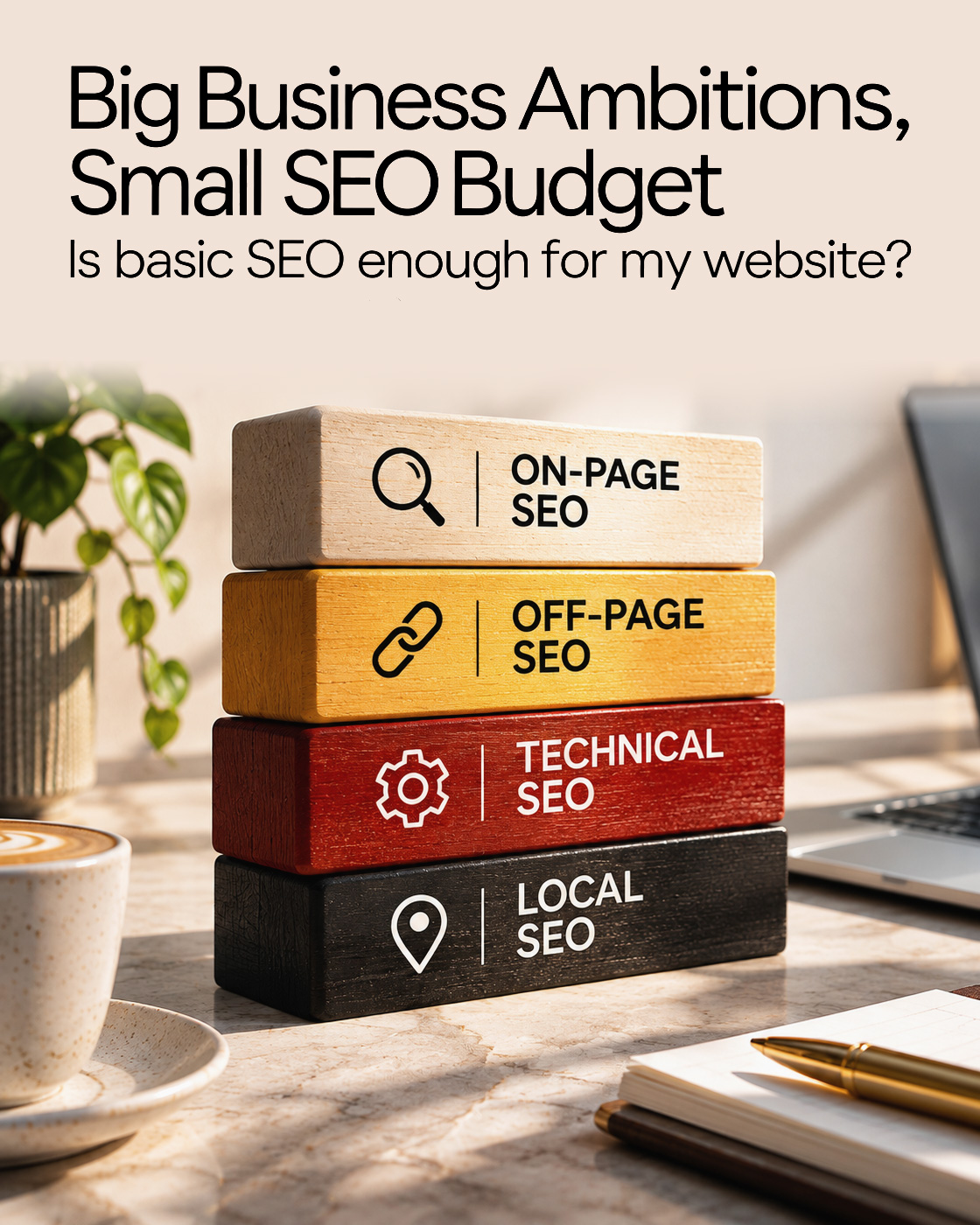
The budget-friendly option under scrutiny
Budget SEO comes with a wonderfully vague label. There’s no universal checklist, so the deliverables matter more than the name. Usually, it’s a contained project concentrating on high-priority pages. Picture a neighbourhood physiotherapist who wants local patients to discover the clinic. Relevant service titles, accurate location details and a Google Business Profile can help nearby searchers identify a suitable provider. Add sensible internal linking, an indexing check and Search Console access, and there’s a credible starting point. Is basic SEO enough for my website? For a modest operation serving one area, quite possibly.
Here’s where that attractive quote calls for a closer inspection: the boundaries. Fewer URLs receive individual attention, rival analysis tends to be lighter and complex development stays outside the agreement. The basic SEO versus advanced SEO decision changes dramatically for a practice opening six branches or an online shop expanding into new categories. Is basic SEO enough for my website? Ask your agency which URLs receive work, how outcomes will be judged and what another phase would cost. A modest fee can be strategic. Vague deliverables? Less charming.
What you typically get:
Essential keyword research, optimisation of selected pages, basic SEO copy adjustments and checks that Google can access your website. These improvements can boost SEO audit scores, although deeper technical issues and overlooked pages may still affect the overall result.
Best suited to:
Start-ups, small businesses and local service providers with straightforward websites, limited competition and modest marketing budgets.
What a bigger investment brings to the party
Is basic SEO enough for my website? Try asking that when a competing florist appears for ‘same-day flower delivery’ while your gorgeous new site only attracts people searching your business name. Ouch. Comprehensive SEO investigates what potential customers type into Google, how fierce the competition is and which searches suggest someone wants to spend money. SEO copywriters then transform those findings into persuasive product descriptions, compelling service content and helpful articles that answer genuine customer questions. Every headline, paragraph and page title has a purpose – attracting the right audience and encouraging them to take action.
And the specialists have plenty more to tackle! They improve loading speeds, organise website navigation, resolve technical errors that affect Google’s access and protect existing search visibility during a redesign. They can also develop strategies to attract credible links from other websites and track which visits generate enquiries or purchases. That’s the basic SEO versus advanced SEO distinction – deeper research, tailored copywriting and specialist expertise working towards measurable business growth. So, Is basic SEO enough for my website? When attracting new customers through Google is a serious commercial priority, investing more can make considerably more sense.
What you typically get:
Extensive keyword research, competitor analysis, professional SEO copywriting, website-wide technical optimisation, improved internal linking and performance tracking. This comprehensive approach can produce stronger audit scores across your website while giving your business greater opportunities to attract relevant traffic and convert visitors into customers.
Best suited to:
Growing brands, established businesses and e-commerce retailers targeting competitive markets, multiple locations or ambitious customer acquisition goals.
That perfect SEO score might be fooling you
Congratulations! Your homepage scored 100 out of 100. Shall we alert the champagne committee? First, an inconvenient detail: Lighthouse scores describe technical performance during tests. Search relevance, competitor strength and customer action require separate evidence. An impressively speedy homepage attracting irrelevant visits remains a commercial disappointment. So here comes the question: Is basic SEO enough for my website? A shiny rating offers remarkably little evidence. Google explicitly says strong Core Web Vitals contribute to page experience, while excellent results offer zero guarantee of leading rankings.
Then come those third-party SEO audit grades. Impressive on a presentation slide, certainly. At RED Marketing, our SEO specialists aim for outstanding technical scores – and check what those scores achieve. Can Google find the pages selling your services? Are potential customers arriving through relevant searches? Do those visits become calls, bookings or purchases? We investigate the answers, improve copy that attracts the wrong audience and fix issues affecting enquiries. That’s where basic SEO versus advanced SEO gets interesting: deeper analysis and ongoing improvements can make a serious commercial difference. Is basic SEO enough for my website? Sometimes. A perfect 100 with an empty appointment diary? Lovely certificate. Awkward sales report.
AI has a few thoughts
Is basic SEO enough for my website? A smart starting point. But Google now shares the attention with AI-powered answers from ChatGPT, Gemini and beyond. Answer engine optimisation (AEO) helps brands appear in direct answers, while generative engine optimisation (GEO) focuses on visibility in AI-generated responses. They overlap considerably, with SEO supporting both. At RED Marketing, we cover the lot. Fancy getting your brand into more conversations? Email info@redmarketing.biz.
RED Marketing
78 York St, London W1H 1DP, United Kingdom
Phone: +44 7874 160 831
Web: https://www.redmarketing.biz
Frequently asked questions
What should a UGC brief include?
A UGC brief should include the campaign objective, intended customer, core message, mandatory product information, content specifications, call to action, disclosure requirements and usage rights. It should also explain where the creator has freedom to use their own language and style.
Should brands provide UGC creators with scripts?
Scripts should generally be reserved for information that must be communicated exactly, such as regulated claims or legal wording. In other situations, talking points usually produce more natural content than word-for-word scripts.
How many benefits should a UGC video include?
Most short-form creator videos should concentrate on one principal problem or benefit. Additional messages can be tested through separate videos rather than compressed into one crowded piece of content.
Why does some UGC still feel like an advert?
UGC often feels like traditional advertising when it is overly scripted, excessively polished, heavily branded or disconnected from the creator’s normal way of speaking. The appearance may resemble organic content, but the delivery signals that it has been tightly controlled.